Altar Practice · Sacred Space
in Everyday Life
An altar is not a decoration. It is an energetic anchor · a place where the invisible is regularly welcomed. How to set up an altar that truly lives.
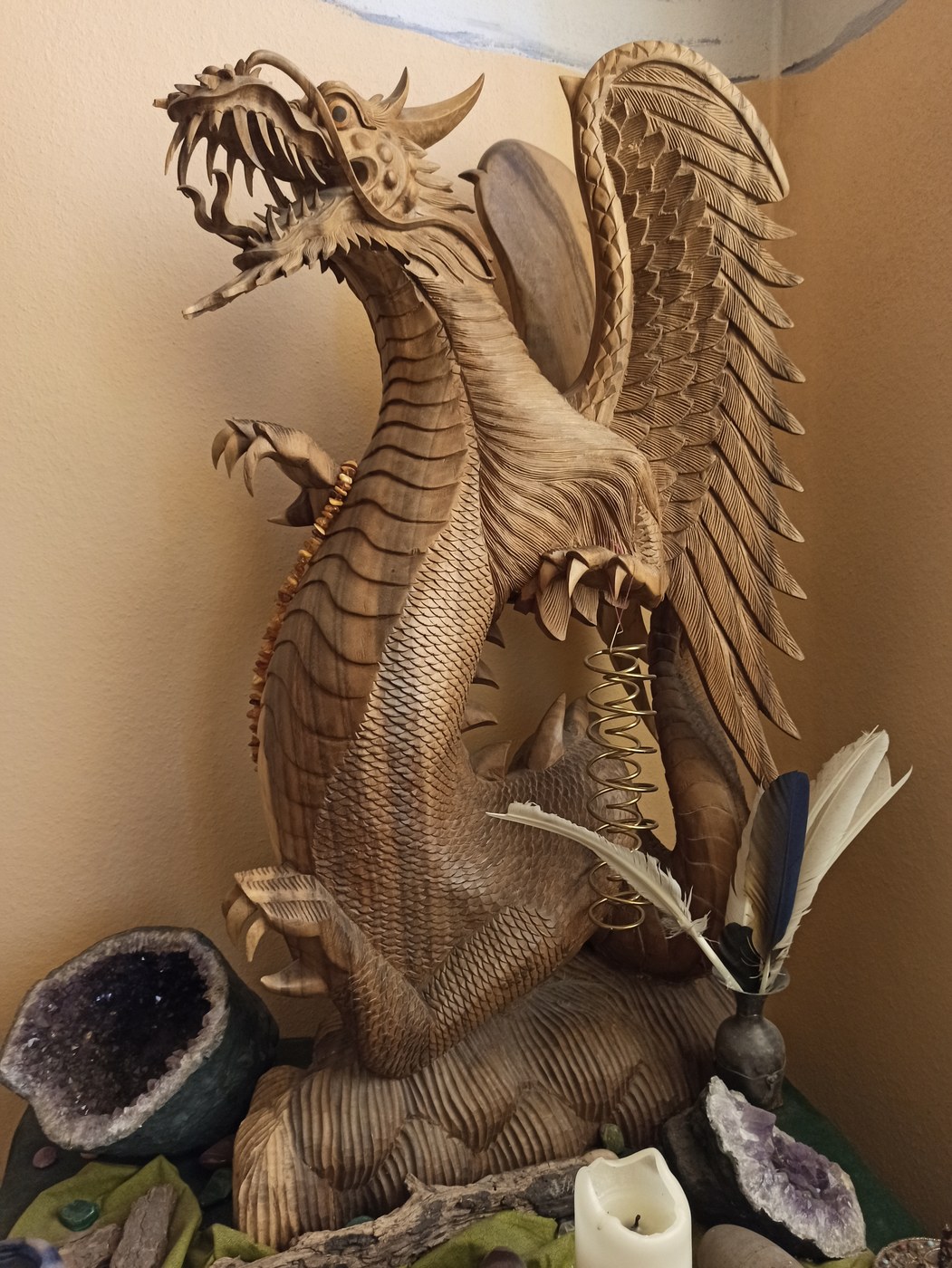
An altar is one of humanity's oldest cultural objects. Even in Palaeolithic caves there are signs of places where offerings were laid down, figures were set up, fire was kept. In every traditional culture of the world there is some form of altar — in the house, in the temple, on a mountain, at a spring. Modern Western living rooms have largely lost this category. Whoever walks a shamanic path rediscovers it. This article describes what that looks like in practice.
This article expands a theme from the general shamanism hub "What Shamanism Really Is".
What an altar actually does
The function of an altar can be described on three levels:
Spatial · it marks a sacred place
When a spot in a room is regularly used for spiritual action, something accumulates there. Not only in the practitioner's perception — but in a quality you can sense in how the room feels. Anyone who steps into a long-used altar space feels it. The room has a different density.
Temporal · it structures the day
An altar visited daily becomes a rhythm-giver. The morning begins there. The evening ends there. Between these poles ordinary life moves. That sounds undramatic but has profound effect. People with an altar practice often report a completely different day-rhythm settling in after a few weeks.
Energetic · it is an anchor
In shamanic-energetic terms: the altar is a physical anchoring for spiritual connections. Whoever honours the ancestors here, calls the power animals, speaks the word of the day, opens a channel that grows more robust over time. The spiritual beings being addressed "know" they are welcome here.
An altar is what turns a shelf into a place. The shelf has not changed · the relationship to it has changed. And over time, that relationship also changes the shelf.
What belongs on an altar
The concrete objects vary by tradition and personal connection. But a few basic categories show up on almost every serious altar:
A central image or symbol
The heart-piece. A figure, a picture, a consecrated object. Not too many — one to three. More overloads the altar. It should be something to which the practitioner has a living relationship.
Candle or light
The light marks the practitioner's presence on the altar. When the candle burns, the practitioner is present — spiritually, emotionally, in intention. Lighting the candle is a small ritual act that "switches the altar on".
Water
A glass or bowl of fresh water. In many shamanic traditions (especially voodoo, but also Shintō) water is a basic offering. It is renewed regularly, often daily.
Incense
Frankincense, myrrh, sandalwood, palo santo, sage, kyphi — depending on tradition. Smoke clears the space, marks the transition into ritual mode, honours the spirit allies.
Natural elements
A stone from a meaningful place. A feather. A piece of wood. Something from your own landscape. These elements anchor the altar in a concrete land, not in an abstract spirituality.
Personal objects
Something that belongs to your own story. A photo of a deceased person. An heirloom. A symbol representing your spiritual lineage.
The structure · many traditions, one principle
A look around the world shows how universal the altar structure is:
- Shintō Kamidana · the Japanese house shrine · a small sanctuary with Ōfuda, water, salt
- Buddhist Butsudan · the Japanese-Buddhist house altar · with Buddha figures and ancestor tablets
- Chinese ancestor altar · with tablets of the deceased, incense sticks, offerings
- Voodoo altar · tailored to the Loa being addressed · colours, symbols, foods for each spirit
- Catholic house altar · Mary, saints, candle · common in Romance-speaking countries
- Hindu Puja altar · divine figures, incense, offerings
However different the traditions look, the basic structure is the same: a place where the sacred has a foothold in everyday life.
The location · where should the altar stand?
A few rules of thumb:
Quiet. No corridor, no TV room. The altar needs a place where it will not constantly be disturbed.
Visible. But not completely hidden either. If you never see it, you forget it. A good place is often in the bedroom, the workroom, or a quiet corner of the living room.
Higher than the floor. In many traditions: an altar does not stand on the floor. A small shelf, table, or chest of drawers is better. Exceptions: certain voodoo altars for earth Loa are deliberately laid out on the floor.
Cardinal direction (when tradition requires it). In Japanese Mikkyō the altar is traditionally oriented eastward or southward. In voodoo there are specific directions for different Loa. Western neo-spirituality often ignores this rule; traditional practice does not.
Care · how an altar stays alive
The most important point: an altar without care is a shelf. What keeps it alive is regularity. A few basic rules:
- Be there briefly each day. Five minutes are enough. Light the candle, change the water (if needed), inwardly greet the present forces. That is enough.
- Weekly more thoroughly. Once a week take time for a longer ritual — perhaps 20–30 minutes. That is when questions, gratitude, requests arise.
- Monthly clearing. Once a month dust the altar, rearrange objects, check whether everything still belongs or whether something has served its purpose.
- Seasonal refresh. Flowers matching the season. Fresh branches. Elements that mirror the current phase of the year.
An altar that evolves
Perhaps the loveliest thing: an altar is not static. It grows with the practitioner. At the beginning, perhaps very simple — a candle, a stone, a picture. After years, often richer, with objects that joined in particular moments. Some things stay for decades. Others come, accompany a phase, and are then released with dignity.
The altar thus mirrors the shamanic path itself. Nothing is fixed once and for all. Everything is allowed to change — with respect for what was and openness for what comes.
Altars at Shamanic Worlds
In the live events of the Wolf Shaman Master Path, altar practice is introduced as one of the daily basic exercises. Each participant is encouraged to set up an altar at home that matches their own spiritual path — with wolf reference, with Japanese elements, with voodoo aspects, or a personal mix. Mark's and Eileen's guidance helps to take the first steps well.
Establish the sacred space
Altar practice is established as a daily exercise on the Wolf Shaman Master Path. The setting up happens with guidance in the live events.