Taichi as
Shamanic Practice
In Chinese parks it is played by old people. In the Daoist cloister it is walked as a way. The slow form is not the easy thing — it is the most demanding.
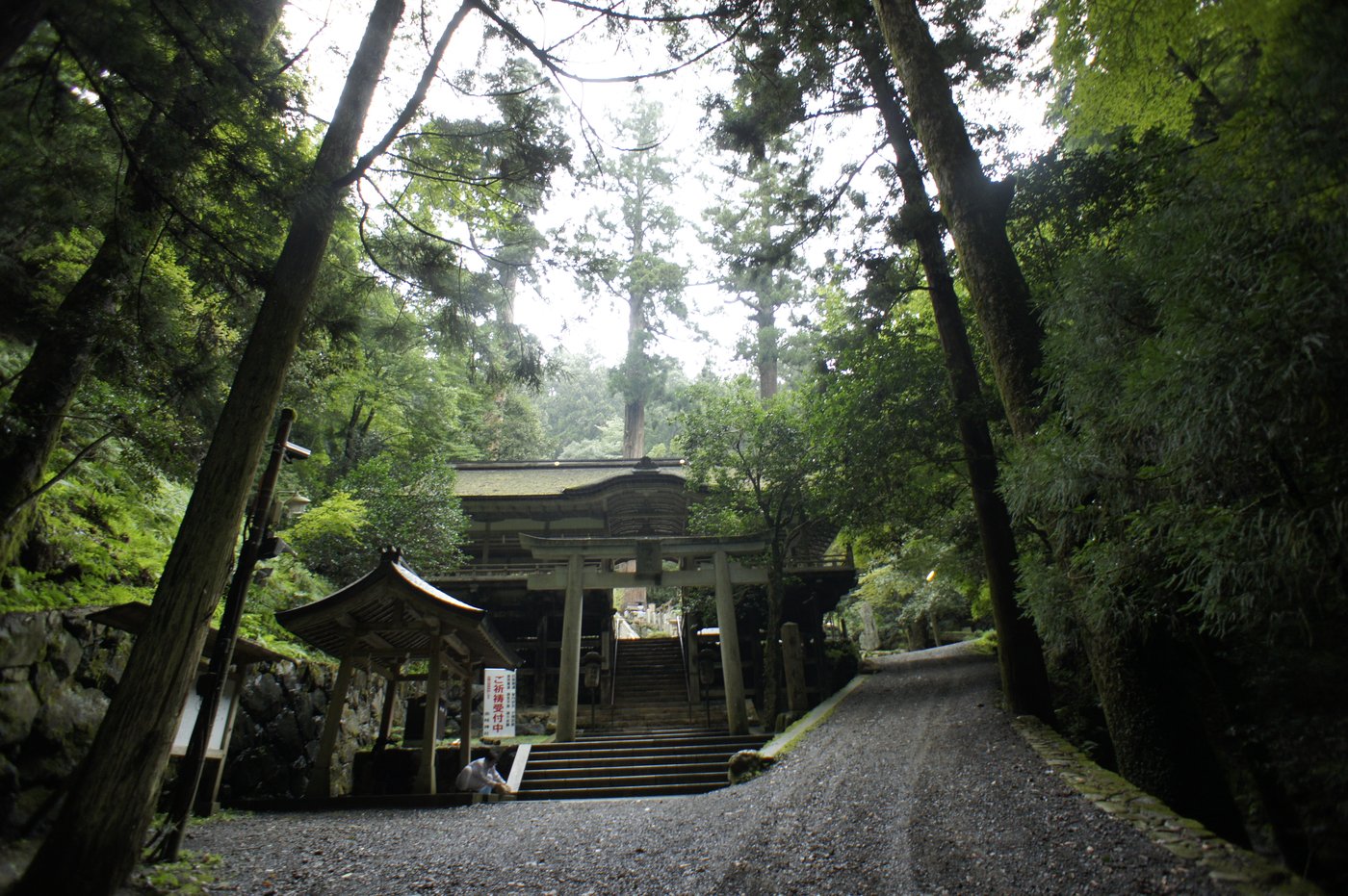
Taichi Chuan (太極拳) means literally "fist of the supreme ultimate". The name points to the Daoist concept Taiji — the highest principle, the origin of all polarities, the well-known symbol of two embracing forms of Yin and Yang. To practise Taichi in this tradition is to practise living into that polarity. The form is not choreography. It is a body-become cosmos-model.
This article is a spoke to the hub "The spiritual warrior in shamanism". It places Taichi inside the warrior context and shows how it works in the shamanic-Daoist reading — beyond images of soft morning gymnastics.
Historical roots
Legend traces Taichi back to the Daoist monk Zhang Sanfeng, said to have lived in the 13th century on Mount Wudang. The historically traceable form emerged later, from the 17th century, in the Chen family — the Chen village in Henan province. From the Chen style developed the better-known styles: Yang, Wu, Sun, and others.
What all styles have in common is the Daoist signature. The slow movement, the relaxedly sunk stance, the work at the Dantian, the circle-geometry — that comes from the same source-region as Bagua and Qigong. Mountain monks, Daoist priests, shamanically inspired body-researchers have built over centuries on the form repertoire that today goes by the name Taichi.
Taichi as moving meditation
The most important difference between Western relaxation gymnastics and real Taichi is the practitioner's state. A Taichi practitioner truly in the flow of the form is in a meditative state — wake, but not tense. Open, but not unbounded. Moved, but not scattered.
This quality is summed up in the classical Taichi texts under the term Song (鬆). Song means "relaxation", but not in the slack sense. A sinew that is Song is ready. A muscle that is Song lets Qi pass. A mind that is Song receives without holding on. That is a shamanic quality.
The Taichi practitioner wins by not pushing back. That is a warrior wisdom. It holds far beyond the martial art.
The principles of the form
- Continuity · the form flows without interruption
- Centering · every movement comes from the Dantian, the abdominal centre
- Yin and Yang · every movement has a full-empty distribution
- Spiral · the force flows in spiral paths · never in straight lines
- Root · the stance stays sunk, the body rooted · without hardening
- Intention · Yi leads the Qi · intention precedes movement
These principles are both guidance for the form and guidance for life. A person who lives Taichi-style moves in difficult situations from their centre, stays rooted, switches smoothly between giving and receiving, lets intention go before action. That is warrior quality, even without a single fighting technique.
Taichi as shamanic opening
After a longer Taichi practice — twenty minutes, thirty minutes, an hour — consciousness changes. That is no imagination, that is a reproducible effect every practised one knows. The head becomes still, the body warm, perception widens. In this state the work can become shamanic — in the sense of "permeable to what is greater than one's everyday mind".
In Daoist cloisters this opening is sometimes used to enter meditations afterwards that would not be possible in the tense everyday consciousness. Taichi is then the door, not the house. The form prepares the practitioner. What comes afterwards comes from stillness.
Taichi and the warrior
As martial art Taichi has a peculiarity: it never works against the other's force. It always goes with, redirects, passes on, draws, instead of stemming. That is the bodily translation of a Daoist principle: Wu wei, "non-doing" — not in the sense of passivity but of "not acting against the law of things".
For the spiritual warrior this is a deep insight. Force that goes with the flow of things is greater than force that works against it. The Taichi warrior does not lose because he does not fight — he wins by staying in the flow while his counterpart exhausts himself.
Taichi in the Shamanic-Worlds practice
At Shamanic Worlds Taichi is one of the accesses into the Daoist strand. It is not transmitted as an independent discipline with competition ambitions — there are schools for that. With us Taichi stands where it originally stood: as gentle tool of consciousness-shift, as body-foundation for the deeper shamanic work.
Taichi as body foundation
Taichi elements flow into the practice of the Wolf Shaman Master Path. The form is experienced as meditation, not as choreography.