Ōkami · The Japanese Wolf
and the Sacred Wolf Shrines
狼 means wolf. Pronounced identically, 大神 means Great Spirit. This doubling is no accident · it is theological signature. In Japan the wolf has been venerated as kami for a thousand years.
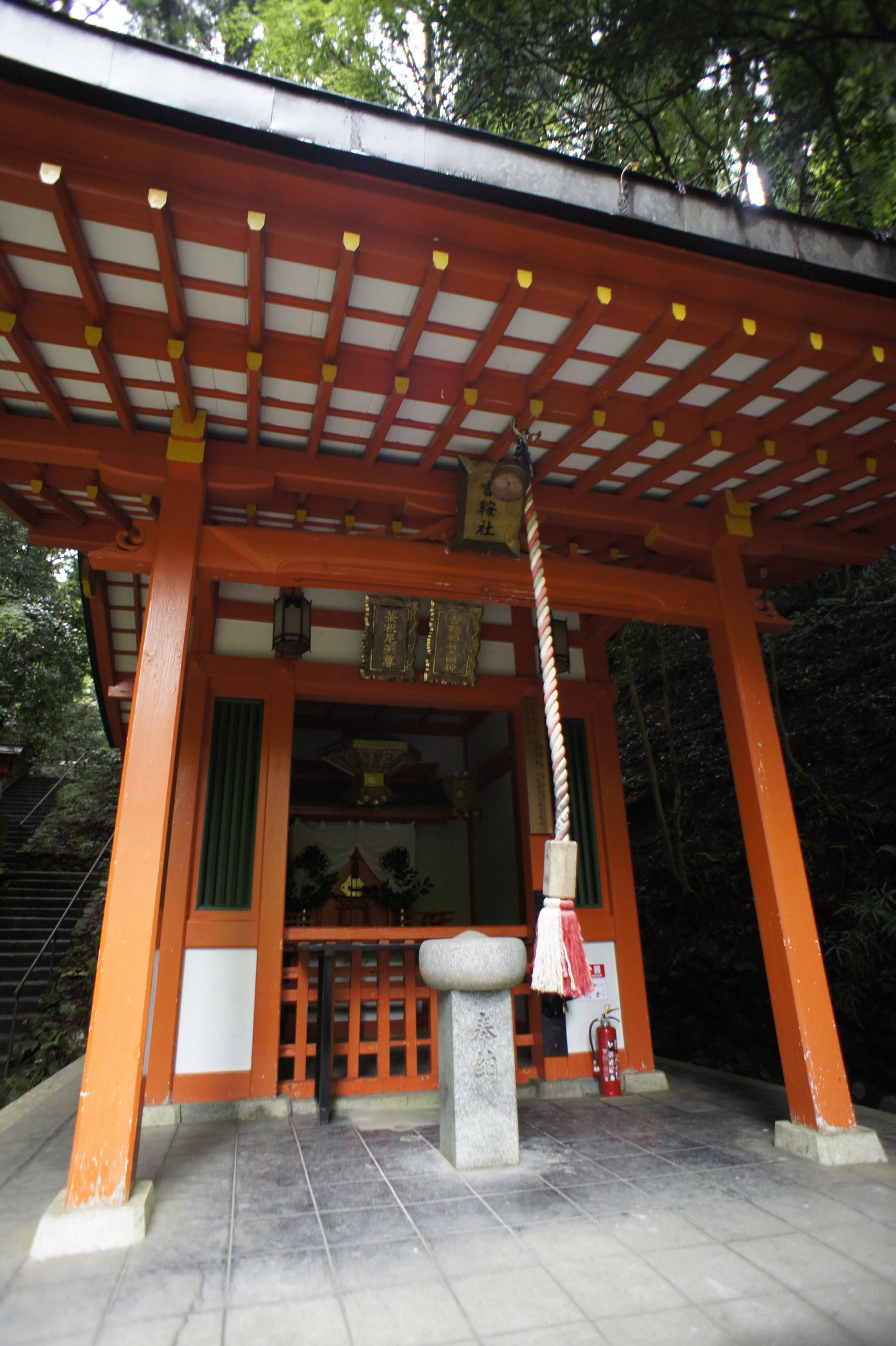
When English-speaking readers hear of the Japanese wolf, they think of the PlayStation game of the same name or of the already extinct Honshū wolf (Canis lupus hodophilax, last confirmed sighting 1905). Both are true · both fall short. In Japanese religious history the wolf is not one animal among many. He is a kami. At several shrines he is worshipped to this day. And the Japanese word itself carries a doubling that already holds this theology inside. (Anyone who has watched Princess Mononoke or played Capcom's Ōkami has already brushed this layer — what follows reveals the living tradition behind those images.)
The double name · 狼 and 大神
Japanese uses several writing systems, of which kanji (the picture-characters taken from China) are the most complex layer. Ōkami is written with two different kanji combinations · both phonetically identical:
- 狼 (ōkami) · wolf · the biological animal
- 大神 (ōkami) · "Great Spirit" or "Great Deity" · a kami of the highest rank
A Japanese hearing the word can infer from context which one is meant · but the homophony is too striking to be accidental. Japanology assumes that the connection of wolf and "Great Spirit" goes back to the deepest layer of Japanese religiosity · to the time before Buddhism arrived (6th century CE), when the land was still organised purely along Shintō.
The animal is called "Great Spirit." Not "animal that serves the Great Spirit." Not "animal accompanied by the Great Spirit." The animal is · already in the language · the Great Spirit.
The sacred wolf shrines
If you travel through Japan and seek the right places, you find shrines whose gates are guarded not by lions or foxes (as at most Inari shrines), but by wolves. These komainu-guardians are not decoration. They announce: a wolf kami lives here.
Mitsumine Shrine (三峯神社) · Saitama
Located in the Chichibu mountains about two hours by train northwest of Tokyo. At 1100 metres, among ancient cedars, stands one of the oldest and most powerful wolf shrines in Japan. The founding is traced back to Yamato Takeru (legendary prince of the 2nd century). The shrine still issues ofuda · paper protective amulets · which families take home as house protection. Some call the shrine "Ōguchi-sama shrine" after the wolf deity Ōguchi-no-Magami. The wolf ofuda from Mitsumine is one of the most sought-after protective objects in Japanese folk devotion.
Musashi-Mitake Shrine (武蔵御嶽神社) · Tokyo
On Mount Mitake in western Tokyo · about two hours from the city centre. Wolves as gate guardians here too, ofuda with wolf motifs here too. The shrine is especially loved by mountaineers and householders · the wolves watch the path and the home. Unlike Mitsumine, Musashi-Mitake is more accessible and well visited. If you are in Tokyo and want to experience the concept of wolf veneration live, this is the easiest doorway.
Other wolf shrines
Across all of Japan further wolf-related shrines exist · Takao-san, Kōzuke-san, in Fukushima and in Kyushu. Wolf veneration was common in many mountain regions before the large-scale rural settlement of the 19th century. When the wolves were eradicated, the shrines remained. The kami has not left · only the biological animal.
Ōguchi-no-Magami · the wolf deity
The concrete kami venerated at these shrines is called Ōguchi-no-Magami (大口真神) · "the true god with the great mouth." The name is no joke · it points to the wolf's task: to bite. But not blindly. Precisely.
Ōguchi-no-Magami has two main functions in Japanese folk religion:
- Protection from evil spirits. Whoever hangs a wolf ofuda in their house places the home under the protection of the wolf deity. Restless spirits, intruders from the other world, lower energies · all are turned back. Even today, rural Japanese households hang such ofuda.
- Protection of the harvest. In mountain regions, wild boar and deer became a plague for the rice fields. The wolf was their natural enemy · keeping the populations in check. When the wolves were eradicated, damage by wild animals exploded · to this day. The memory of this makes the wolf the kami of farmers' gratitude.
Yamato Takeru and the wolf-guide
The legend said to have founded the Mitsumine Shrine is archetypal for the Japanese wolf narrative. Yamato Takeru · a legendary prince of the Yamato court · lost his way travelling through the Chichibu mountains. He could no longer find the path, night fell, he feared spirits and wild animals.
A white wolf appeared, led him through the forest, and brought him safely to the pass. The next morning the wolf was gone. Yamato Takeru understood · this was no ordinary animal. He raised a shrine to honour the wolf kami. From this shrine grew Mitsumine.
The legend is classically shamanic · the animal as guide through the other world, the gratitude poured into a ritual memorial, the relationship transmitted across centuries. What holds for the Sami nomads or Siberian shamanism holds here too. Japan had its wolf shamanism · it remained alive in the shrines.
Ōkami in pop culture
Anyone who knows Japan's anime and gaming culture has already met the word. The video game Ōkami (2006, Capcom) makes the sun goddess Amaterasu into a white she-wolf who restores the Japanese landscape with a magical brush. The game quotes ancient Shintō theology directly · Amaterasu as Ōkami is no creative accident, but a return to the kami mythology.
In anime the wolf appears repeatedly as a sacred being · in Princess Mononoke (Studio Ghibli, 1997) the wolf gods of the mountains are central. The young protagonist San was taken in as a child by a wolf goddess. Miyazaki draws here on the Japanese wolf-kami tradition.
For the anime-socialised audience, Ōkami is no foreign exoticism · he is an already familiar figure now opening as living shamanic reality.
Ōkami in wolf shamanism
In Dr. Mark Hosak's wolf shamanism, Ōkami is one of the three strands of the Great Wolf. The Japanese strand brings into practice:
- Shrine attunement. Anyone who has been to Mitsumine or Musashi-Mitake in Japan brings the resonance of that place into their own practice. Mark's Japan years include this directly.
- The linguistic doubling 狼/大神 as a spiritual foundation · the animal is already the Great Spirit. That is closer to the Japanese nature religion than to the Western animal/god dualism.
- Ofuda power. The paper protective amulet with wolf motif is a concrete ritual object · a bridge between human and Ōkami.
- Wolf as mountain guardian. Whoever performs rituals in Japan or elsewhere in the mountains gains, with Ōkami support, a specific access to mountain kami in general.
Practical access · what you can do
Without initiation, some basic postures can already be taken on:
- On your next forest or mountain walk, take the stance: this place is ensouled · what you see is kami
- Obtain an ofuda (genuine paper protective amulet from Mitsumine Shrine) · available online from official shrine dispatches · hang it in a clear place in the home
- In respect for the Japanese Ōkami, deepen your own wolf practice · not as cultural appropriation, but as recognition that this strand resonates
- Read the book The Master Path of the Wolf Shamans · the Ōkami aspect is covered there in depth
Ōkami in the Master Path
Encounter with the Japanese wolf kami happens in the live events of the Wolf Shaman Master Path · alongside the African strand (golden jackal, Anubis, Loup de Baron) and the Northern European strand (Fenrir, wolf cross).
Came in through Princess Mononoke or Naruto? The actual shrines, ofuda and rituals are here. Join the Japanese Grimoire Society.