Escrima and Arnis ·
Philippine Martial Arts in Shamanic Depth
Two sticks, one body, centuries-old knowledge. Behind the clarity of the technique lies an animistic world · ancestors, spirits, precision.
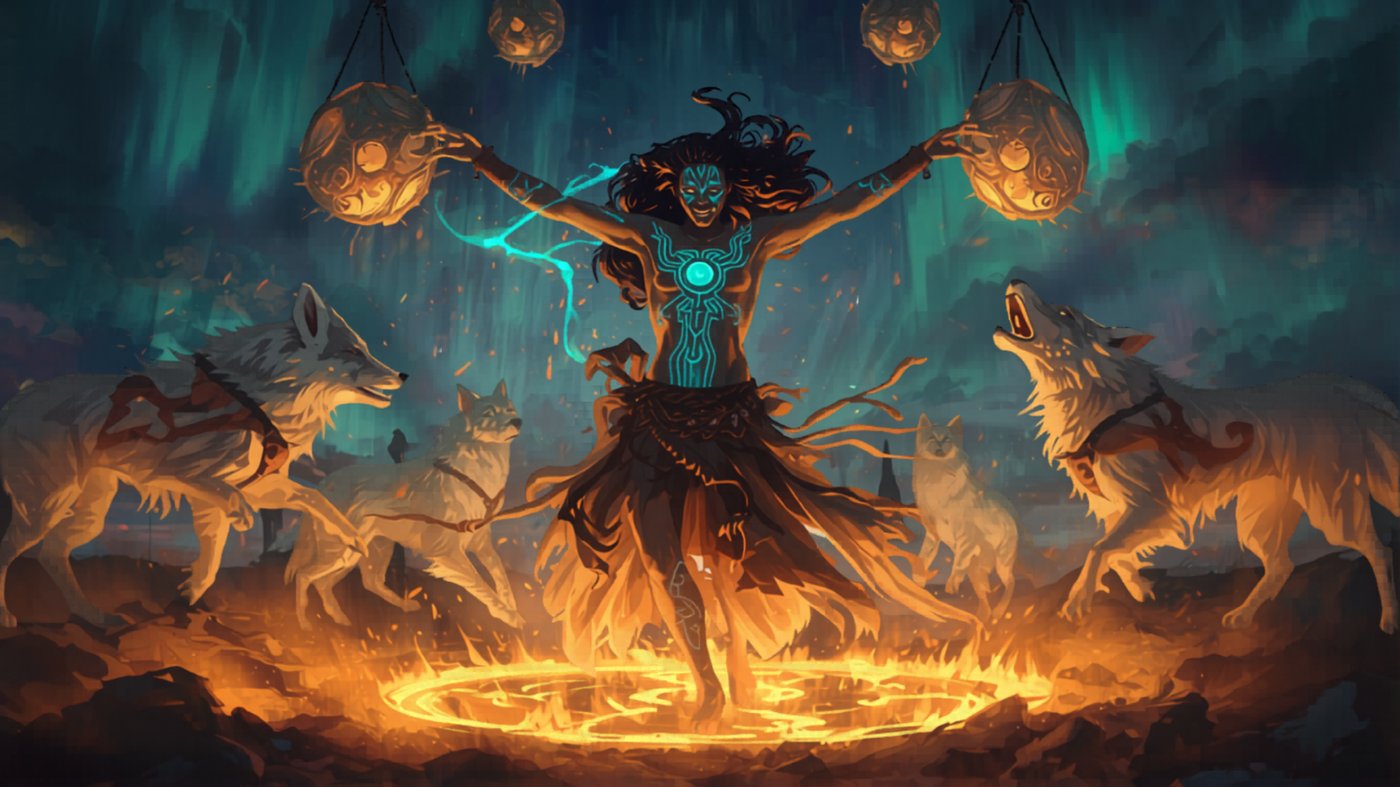
The Philippine martial arts are usually labelled in the West under the names Escrima, Arnis, or Kali. The distinction is partly regional (Escrima more central-Philippine, Arnis the official national sport, Kali the older, sometimes archaically connoted term), partly stylistic. In substance it is an art that works with sticks, blades, and empty hands — and which in its depth reaches far beyond physical technique.
This article is a spoke to the hub "The spiritual warrior in shamanism". It looks at Escrima and Arnis in the reading that lets them be understood as shamanically grounded warrior arts — not as mere systems of self-defence.
Roots in an animistic world
The Philippine island world was, long before Spanish colonisation, a space in which animism, ancestor veneration, and local shamans — the Babaylan — played a central role. The warriors of that world (Mandirigma) stood in close relationship with these spiritual structures. A warrior did not enter combat without ritual. A warrior often wore amulets (Anting-Anting) that conferred specific powers.
With Spanish colonisation (from 1565) part of this tradition was suppressed or transferred into Catholic forms. But the martial art itself survived — partly in hiding, partly disguised in dance forms like the Sayaw. The spiritual layer was preserved, even when no longer named openly. In many family traditions, rituals are still performed before training, ancestors invoked, blessings spoken.
An Escrima strike performed with respect for the ancestors feels different from one that is only trained technique. This is not superstition. It is attention to a layer that Western combat-sport culture has often forgotten.
Structure of the art
Escrima/Arnis works with two striking peculiarities that distinguish it from many other martial arts:
Weapon first
Unlike Karate or Taekwondo, Escrima does not begin with empty hands but with the stick (Bastón or Olisi, usually of rattan). The idea: whoever first trains with the weapon also moves more precisely with empty hands — because the body axis is structured by handling the weapon. This is unusual pedagogy, but it works in its own way.
Flow and reaction
The practice works heavily with partner drills in which two practitioners exchange movements at high speed. The art is not primarily a collection of static techniques but a refinement of reaction. The trained Escrima practitioner is meant to react fluidly in every situation, without inserting the head between stimulus and answer. This is a shamanic quality.
The shamanic dimension
In a seriously practised lineage, several shamanic elements become palpable:
- Ancestor connection · many styles trace back to a founder whose name is invoked in practice · the lineage is not abstract but concretely connected
- Amulet culture · Anting-Anting practice in some traditions · the question of what protects a warrior is answered not only physically but spiritually
- Naming · the one initiated receives a new name in some lineages · a shamanic act of identity shift
- Gesture before practice · in many lineages incense is burnt, consecration done, or a short blessing spoken · practice thus becomes ritual, not only training
Not every Escrima school cultivates these elements. In modern sport-Arnis they are often faded. But in the family lineages where the art is still preserved in its wholeness, they are present and natural.
What Escrima gives the spiritual warrior
For someone walking the shamanic warrior path, Escrima opens things that other arts do not offer so directly:
Clarity in reaction
Through fast partner drills the body learns to decide in the moment. Thinking is taken out of the way. Whoever has that in the body once carries it into other life areas too — into difficult conversations, into emergencies, into moments where quick action is needed.
Respect for the weapon
The weapon in Escrima is not an aggressive tool but an extension of intention. Whoever holds the stick rightly moves differently from one who swings it. The stick teaches a certain seriousness — and this seriousness opens a new space of attention.
Connection to an animistic warrior world
For people coming mainly from European and Asian traditions, the encounter with the Philippine warrior world is often an expansion. A world in which ancestors and amulets are taken for granted, in which the split between body and spirit was never fully completed. That is an access to warriorhood some Western seekers only find here.
Escrima in the Shamanic Worlds practice
At Shamanic Worlds, Escrima — like Bagua, like Tai Chi, like ninjutsu — flows as a body element into the broader shamanic path. It is not offered as a stand-alone combat-sport. Whoever wants to train the bodily discipline of the Philippine arts in depth will find specialised schools; part of that trail leads back to the Philippine tradition itself.
With us, the focus is on integrating the postures and reactive qualities of the Philippine warrior tradition into shamanic work. That means: reacting clearly, respecting the weapon of one's own intention, listening to the ancestors of one's own path. These are qualities every spiritual warrior can use, independent of their concrete school.
Tengu Akasha Dōjō · bodily transmission
The bodily-technical layer of Escrima work is touched at the Tengu Akasha Dōjō, there within the broader martial arts lineage of Dr. Mark Hosak. Whoever wants to walk the physical path intensively will find the matching complement to the shamanic depth at Shamanic Worlds.
tengu-akasha-dojo.dePhilippine martial arts in shamanic frame
Escrima and Arnis flow as body element into the practice of the Master Path. Shamanic depth is the centre, not competition.